Welcome to our book series „Bukowski SHOTS“ – the digital edition.
We’ve decided to make our book, „Bukowski SHOTS – A Guide to Mixed Drinks,“ available to the public for free. It was born during the pandemic as a way to survive tough times—both financially and mentally—and today, we are gradually releasing it online.
Each installment represents one chapter or section of the book, adapted for the web. At the end of every article, you’ll find a link to the next part so you can keep reading seamlessly.
And once we get to the shots themselves, you can look forward to our personal recommendations and those classic „bizarre bar tales“ that are simply part of the Bukowski experience.
Borovička
Borovička (juniper brandy) has had a peculiar fate in Slovakia. A drink that once served as a medicine and a point of pride eventually devolved into a common „moonshine“ and, for a time, even became a synonym for cheap alcohol. It is only in recent years that borovička has begun to return to where it belongs: among authentic, high-quality spirits.
An interesting perspective also came from abroad. In the 21st century, the Žufánek family became a household name among producers of premium distillates in the Czech Republic. They didn’t venture into their first borovička until 2011—but before doing so, Martin Žufánek traveled to Slovakia to find inspiration in the drink’s homeland. To his disappointment, he found none. When did it happen that in the very birthplace of famous distillers, this spirit was degraded to the cheapest mass-produced alcohol?
The word borovička itself is derived from borievka—the juniper bush. The name is also linked to ancient terms for conifers (Old Slavic bor, Old Norse borr). It was likely the abundance of juniper (juniperus) in our forests that led our ancestors to hold it in such high regard—not just for its accessibility, but for its medicinal effects.
Juniper berries were a renowned remedy. As early as the 18th century, the berries were used as a disinfectant. And if you recall the plague doctors with their „beak“ masks, juniper berries were a key part of their protective herbal mix.
In the Slovak News (1855), it was noted that large areas of the Slovak hillsides were covered by juniper, producing round black berries rich in juniper oil—and that no one should consider juniper a lowly thing, as it frequently served as medicine in households. Borovička was also distilled from these berries and described as a „healthy beverage.“
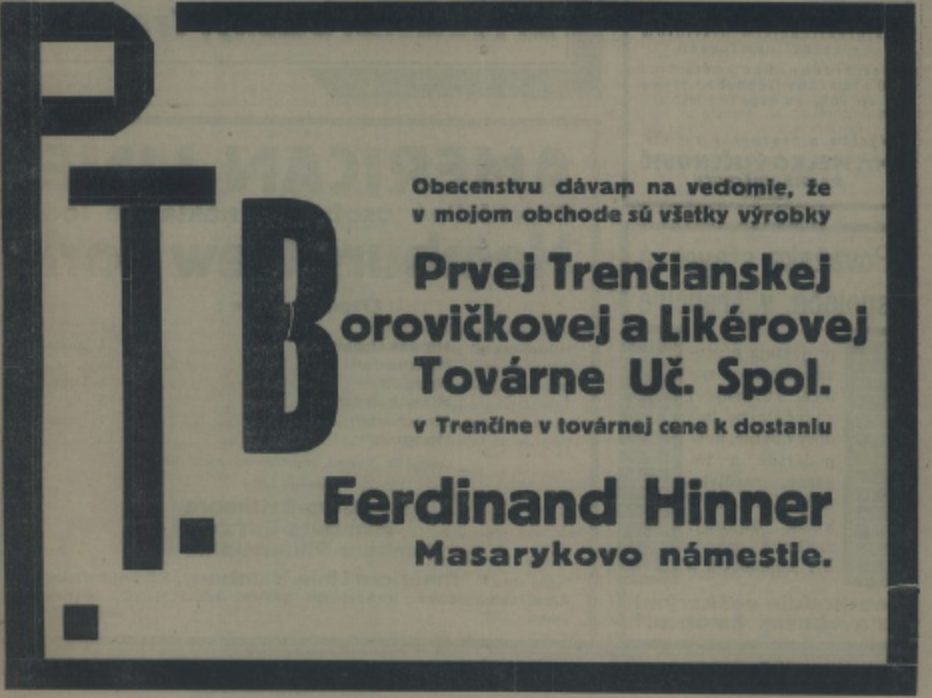
The person who produced it was called a borovičkár—and it is no wonder they could market their product as medicine. The most famous borovička of that era was Trenčín’s Juniperus, which to this day boasts the title of the oldest trademarked borovička in the world. Distilling began in 1905, and it was later registered at the International Bureau for Inventions and Patents in Geneva.
However, during the first half of the 20th century, borovička gradually shifted from the „medicine“ category to the „liquor“ category. By 1928, the Bulletin of the Union of Slovak Distilleries discussed how brandy, borovička, and similar spirits must not be labeled as medicinal, since they did not contain the ingredients listed in the official pharmacopoeia.
Despite this, shortly before World War II, the producers from Slovlik in Trenčín sold Koniferum borovička with the slogan: „Medicinal borovička is the best-proven remedy for poor digestion and stomach cramps.“
After the war, borovička quickly became a mass-market commodity, giving rise to the classic Slovak pub combination: borovička + beer. This did no favors for the reputation of a drink that is partially similar to gin. And so, even after the year 2000, when Žufánek searched for high-quality borovička in Slovakia, he mostly found only cheap, industrial spirits.
Fortunately, borovička is experiencing a renaissance today. Several Slovak producers have started making it honestly as a true distillate. Marketers are also doing their part—for instance, by linking the celebration of St. John’s Day (June 24th) with International Borovička Day.
From a forest remedy, to „revenge from the forest,“ to a forest treasure? We shall see…