


Tinder didn’t kill the bar. It just changed its role
How apps changed flirting, why dating burnout is setting in, and why a chance encounter over a drink might be having its moment again.
Do you remember those scenes from the nineties or the early 2000s?
A man spots a woman on the other side of the bar. He sends a drink over via the bartender. He builds up his courage for a moment, then walks over and says the first witty—or catastrophically awkward—pick-up line that comes to mind.
Or two groups of friends cross paths on the dance floor. Someone grabs someone’s hand, a quick shot follows, a few glances are exchanged, and the rest of the night takes its own course.
Dating had one quality we often lack today: we had no idea what was coming next.
Today?
Before you even sit down for a first drink with someone, you often already know where they go on vacation, what music they listen to, roughly what they do for a living, how many mutual friends you share, and what the last three years of their life looked like on Instagram.
The first glance has shifted to a screen. The first flirt to a chat. And the first rejection often happens before two people even find themselves in the same room.
Yet online dating is no longer a fringe way to meet people. Stanford’s How Couples Meet and Stay Together study showed that in the US, the internet has become the most common way heterosexual couples meet. Among couples who met in 2017, roughly 39 percent connected online.
But then something interesting happened.
Digital dating solved the problem of a lack of options. And created the problem of an abundance of them.

From Colleague and Friend to Algorithm
Just a few decades ago, our potential partners were largely „filtered“ by life itself. They were classmates, colleagues, friends of friends, people from the neighborhood, or someone we met out at a venue in the evening. The internet dramatically changed this system.
Stanford data shows, for instance, that the proportion of heterosexual couples who met through work or as colleagues dropped from roughly 19 percent to 11 percent between 1995 and 2017. Even more dramatic was the decline of one of the world’s oldest matchmaking institutions: the friend who knows someone you should meet.
That’s because online dating eliminated the middleman. On Tinder, you don’t need a friend to introduce you to someone. You don’t need to work at the same company or frequent the same bar. You just need a phone.
This brought a massive advantage. Suddenly, we gained access to people we likely never would have crossed paths with in our own social bubbles. Yet at the same time, romance turned a bit into a catalog.
Photo…
Height…
Job…
Interests…
Swipe…
Next…
Next…
Next…
And somewhere among thousands of potential partners, the modern dating paradox was born: the more options we have, the easier it is to feel that maybe, just one swipe away, someone better is waiting.
Tinder Burnout Isn’t Just an Internet Meme
The term „dating app burnout“ no longer describes just the feeling of someone lazily swiping profile after profile past midnight.
In 2024, researchers published a longitudinal study of active dating app users, tracking signs of emotional exhaustion, feelings of ineffectiveness, and depersonalization when using dating sites over time. The results showed that for a portion of users, fatigue from online dating can deepen with continued use.
A large survey by the Pew Research Center also points to a strange paradox in online dating. Women often feel overwhelmed by the volume of messages, while men are more likely to feel insecure because they receive so few. Among American women who recently used dating apps, 54 percent reported feeling overwhelmed by the sheer volume of messages at least sometimes.
So we have technology designed to make dating easier, yet it manages to exhaust both sides in completely opposite ways.
Even more interesting is that user fatigue is starting to transform the apps themselves. On August 11, 2026, Bumble announced one of the largest changes in its history, removing the rule its brand was built on since 2014—that in a heterosexual match, the woman must start the conversation. Under the new system, either partner can message first. The company introduced this change precisely at a time when the entire sector is trying to combat user fatigue from swipe-based dating.
The numbers show this isn’t just a trendy topic on TikTok. Match Group, the owner of Tinder and other dating platforms, reported a six percent year-over-year decline in paying users, down to 13.3 million in the second quarter of 2026. Bumble reported an even steeper year-over-year drop in total paying users for the fourth quarter of 2025—down by 20.5 percent.
This doesn’t mean the death of online dating. It does mean, however, that the model of endless swiping has hit its limits.
Why Approaching Someone at a Bar Might Be Harder Today
Perhaps our social reflexes have changed as well. On an app, rejection is relatively sterile:
Swipe right.
No match.
The end.
Nobody at the next table saw it happen.
In the real world, you have to cross a room, make eye contact, and say something to a person when you have absolutely no idea if they want to meet you. The risk is higher. But so is the reward.
At the same time, perceptions of personal boundaries have shifted over recent decades. Behavior once viewed as persistent courtship can today, quite legitimately, be seen as harassment. That is a real change.
Modern flirting requires a bit more social intelligence: recognizing a glance, a smile, returned interest—and also knowing how to accept a simple „no.“
Perhaps we aren’t flirting less because younger generations stopped craving relationships, sex, or romance. The rules of the game have simply changed.
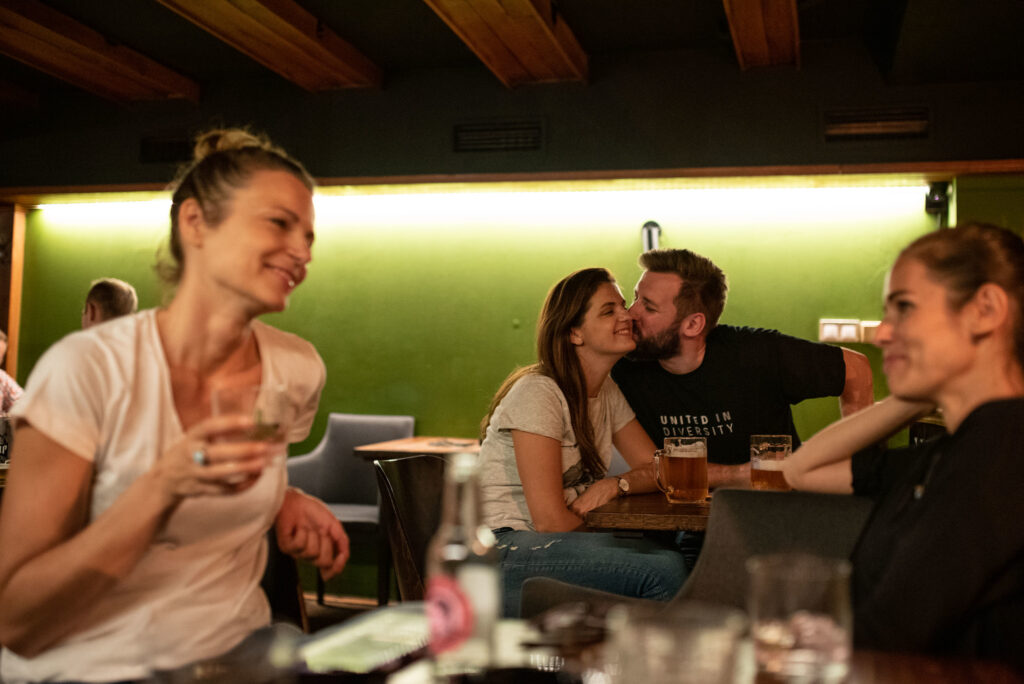
And Then Comes the Moment When the Phone Has to Disappear From the Table Anyway
And here lies the paradox of the entire digital revolution.
You can have a perfect match. You can text for two weeks. You can share the exact same taste in music, political views, dogs, and favorite TV shows.
But sooner or later, you have to meet.
And within a few seconds, the brain begins processing thousands of data points that a profile simply cannot transmit:
How the person laughs
How they speak
How they make eye contact
How they treat the waiter
Whether silences between sentences feel awkward or comfortable
Whether the humor works
Whether their scent works
Whether the chemistry is simply there
An app can tell you that you share the same hobbies. A bar will tell you in three seconds if there’s a spark.
The internet didn’t kill the bar—it turned it into the venue for step two.
And right here is one of the most interesting details of the Stanford research. The proportion of American heterosexual couples who reported meeting in a bar or restaurant actually rose between 1995 and 2017, from roughly 19 to 27 percent.
At first glance, this looks like fantastic news for bars. But researchers uncovered a catch.
When they removed people who first met online and only subsequently had their first in-person date at a bar or restaurant from the data, the growth disappeared. Traditional, spontaneous meetups directly inside venues were actually declining.
This perfectly encapsulates the last twenty years. The internet didn’t kill the bar; it just changed its role. You used to find a person there. Then, you went there to verify a person you found on the internet.
And now comes an interesting question: Can the bar become a place where we simply run into someone by chance once again?
Offline Encounters Have One Advantage the Algorithm Can’t Replicate
Last year, a major international study brought this debate back into the spotlight. Researchers analyzed 6,646 individuals in romantic relationships across 50 countries and found that respondents who met their partners offline reported, on average, slightly higher relationship satisfaction and greater intensity of experienced love than those who met online. Differences were also noted in intimacy, passion, and commitment.
However, an important caveat is necessary. The study does not prove that meeting someone in a bar automatically guarantees a happier marriage. Correlation is not causation. Furthermore, older research yields less definitive results; the Stanford study itself found no convincing evidence that the method of meeting determines the long-term success of an established relationship.
Still, that doesn’t change one fundamental advantage of the offline world.
When you meet someone through friends, at a concert, in a cafe, or at a bar, there is almost always a shared context:
Shared music
A shared space
A shared friend group
A shared situation
The algorithm tries to calculate compatibility. The real world lets you experience it.
The Bar as a Hunting Ground May Be Fading. The Bar as Social Infrastructure Can Grow.
And this is precisely where I believe the role of modern bars is shifting.
The nineties model of the „hunting ground“—where the music pounds so loudly that the only way to communicate is by screaming into someone’s ear—might not be the ideal environment for how people connect today. Yet people still need places where they can naturally come into contact with others.
Not necessarily because they told themselves that evening, „I have to find someone tonight.“ On the contrary. The best social environments often emerge where meeting people is a byproduct of something else happening:
A concert
A pub quiz
A DJ set
A tasting session
A communal table
A conversation at the bar counter
A bartender dropping a joke and accidentally connecting two separate groups